Friday, October 12, 2012

Ancient City Found in India, Irradiated from Atomic Blast

Radiation still so intense, the area is highly dangerous. A heavy layer of radioactive ash in Rajasthan, India, covers a three-square mile area, ten miles west of Jodhpur. Scientists are investigating the site, where a housing development was being built.

For some time it has been established that there is a very high rate of birth defects and cancer in the area under construction. The levels of radiation there have registered so high on investigators' gauges that the Indian government has now cordoned off the region. Scientists have unearthed an ancient city where evidence shows an atomic blast dating back thousands of years, from 8,000 to 12,000 years, destroyed most of the buildings and probably a half-million people. One researcher estimates that the nuclear bomb used was about the size of the ones dropped on Japan in 1945.

The ruins of Harappa

 The Mahabharata clearly describes a catastrophic blast that rocked the continent.

"A single projectile charged with all the power in the Universe…An incandescent column of smoke and flame as bright as 10,000 suns, rose in all its splendor…it was an unknown weapon, an iron thunderbolt, a gigantic messenger of death which reduced to ashes an entire race.

"The corpses were so burned as to be unrecognizable. Their hair and nails fell out, pottery broke without any apparent cause, and the birds turned white.

"After a few hours, all foodstuffs were infected. To escape from this fire, the soldiers threw themselves into the river."


A Historian Comments


Historian Kisari Mohan Ganguli says that Indian sacred writings are full of such descriptions, which sound like an atomic blast as experienced in Hiroshima and Nagasaki. He says references mention fighting sky chariots and final weapons. An ancient battle is described in the Drona Parva, a section of the Mahabharata.

"The passage tells of combat where explosions of final weapons decimate entire armies, causing crowds of warriors with steeds and elephants and weapons to be carried away as if they were dry leaves of trees," says Ganguli.

"Instead of mushroom clouds, the writer describes a perpendicular explosion with its billowing smoke clouds as consecutive openings of giant parasols. There are comments about the contamination of food and people's hair falling out."


Archeological Investigation provides information


Archeologist Francis Taylor says that etchings in some nearby temples he has managed to translate suggest that they prayed to be spared from the great light that was coming to lay ruin to the city.

"It's so mid-boggling to imagine that some civilization had nuclear technology before we did. The radioactive ash adds credibility to the ancient Indian records that describe atomic warfare."

Construction has halted while the five member team conducts the investigation. The foreman of the project is Lee Hundley, who pioneered the investigation after the high level of radiation was discovered.
There is evidence that the Rama empire (now India) was devastated by nuclear war. The Indus valley is now the Thar desert, and the site of the radioactive ash found west of Jodhpur is around there.
Consider these verses from the ancient (6500 BC at the latest) Mahabharata:

Atomic explosion


…a single projectile
Charged with all the power of the Universe.

An incandescent column of smoke and flame

As bright as the thousand suns
Rose in all its splendour…
a perpendicular explosion
with its billowing smoke clouds…
…the cloud of smoke
rising after its first explosion
formed into expanding round circles
like the opening of giant parasols…

..it was an unknown weapon,
An iron thunderbolt,
A gigantic messenger of death,
Which reduced to ashes
The entire race of the Vrishnis and the Andhakas.
…The corpses were so burned
As to be unrecognisable.
The hair and nails fell out;
Pottery broke without apparent cause,
And the birds turned white.

After a few hours
All foodstuffs were infected…
…to escape from this fire
The soldiers threw themselves in streams
To wash themselves and their equipment.


Until the bombing of Hiroshima and Nagasaki, modern mankind could not imagine any weapon as horrible and devastating as those described in the ancient Indian texts. Yet they very accurately described the effects of an atomic explosion. Radioactive poisoning will make hair and nails fall out. Immersing oneself in water gives some respite, though it is not a cure.

When excavations of Harappa and Mohenjo-Daro reached the street level, they discovered skeletons scattered about the cities, many holding hands and sprawling in the streets as if some instant, horrible doom had taken place. People were just lying, unburied, in the streets of the city. And these skeletons are thousands of years old, even by traditional archaeological standards. What could cause such a thing? Why did the bodies not decay or get eaten by wild animals? Furthermore, there is no apparent cause of a physically violent death.

These skeletons are among the most radioactive ever found, on par with those at Hiroshima and Nagasaki. At one site, Soviet scholars found a skeleton which had a radioactive level 50 times greater than normal. Other cities have been found in northern India that show indications of explosions of great magnitude. One such city, found between the Ganges and the mountains of Rajmahal, seems to have been subjected to intense heat. Huge masses of walls and foundations of the ancient city are fused together, literally vitrified! And since there is no indication of a volcanic eruption at Mohenjo-Daro or at the other cities, the intense heat to melt clay vessels can only be explained by an atomic blast or some other unknown weapon. The cities were wiped out entirely.

While the skeletons have been carbon-dated to 2500 BC, we must keep in mind that carbon-dating involves measuring the amount of radiation left. When atomic explosions are involved, that makes then seem much younger.

Interestingly, Manhattan Project chief scientist Dr J. Robert Oppenheimer was known to be familiar with ancient Sanskrit literature. In an interview conducted after he watched the first atomic test, he quoted from the Bhagavad Gita:

"'Now I am become Death, the Destroyer of Worlds.' I suppose we all felt that way."

When asked in an interview at Rochester University seven years after the Alamogordo nuclear test whether that was the first atomic bomb ever to be detonated, his reply was,

Ancient cities whose brick and stonewalls have literally been vitrified, that is, fused together, can be found in India, Ireland, Scotland, France, Turkey and other places. There is no logical explanation for the vitrification of stone forts and cities, except from an atomic blast.


Giant Unexplained Crater Near Bombay


Another curious sign of an ancient nuclear war in India is a giant crater near Bombay. The nearly circular 2,154-metre-diameter Lonar crater, located 400 kilometres northeast of Bombay and aged at less than 50,000 years old, could be related to nuclear warfare of antiquity.

Giant Unexplained Crater Near Bombay


No trace of any meteoric material, etc., has been found at the site or in the vicinity, and this is the world's only known "impact" crater in basalt. Indications of great shock (from a pressure exceeding 600,000 atmospheres) and intense, abrupt heat (indicated by basalt glass spherules) can be ascertained from the site.  

David Hatcher Childress in Nexus Magazine:

"The crater is formed in the basalt rock of thickness 600-700m (2,000 to 2,200 feet). This rock is made of many layers or flows which were laid why volcanic activity at various times, five of such flows are exposed at the crater rim. Thickness of these flows ranges from 5 to 30m.

The crater is about 150m (500 feet)deep and has average diameter of 1830m (1.4 miles). The elevated rim consists of 25m of bedrock and 5m of ejecta over it. This ejecta blanket is spread over about 1350m (4,400 feet) away from the crater rim and slopes away by 2-6°. The uppermost region of ejecta contains the deposits that were melted due to the impact".

Lonar crater


“Lonar is a place of obscurities, especially as the only meteoric crater formed in basaltic terrain. It has remained relatively intact due to low degree of erosion by environmental agents, making it an excellent model for study. However, several strange things happen here:

1. The lake has two distinct regions that never mix — an outer neutral (pH7) and an inner alkaline (pH11) each with its own flora and fauna. You can actually do a litmus paper test here and check this for yourself.

2. There is a perennial stream feeding the lake with water but there seems to be no apparent outlet for the lake’s water. And it is also a big unsolved mystery where the water for the perennial stream comes from, in a relatively dry region like Buldhana. Even in the driest months of May and June, the stream is perpetually flowing. Lonar generates questions and more questions”. Lilyn Kamath


References

Bibliography
 
1. Best Evidence?, by Philip Coppens; Are the Indian remains of Mohenjo Daro and Harappa, their sudden abandonment and the apparent discovery of an ancient site with a layer of radioactive ash the best available evidence for the possibility that our ancient ancestors possessed a highly advanced technology – which might have included atomic warfare?
 
2. Nuclear events in Ancient India, Rajasthan: Evidence of Ancient Atomic Explosion
 
 
 http://veda.wikidot.com/ancient-city-found-in-india-irradiated-from-atomic-blast

Myth of Ancient Nuclear War


Was the ancient indian war of mahabharatha a nuclear war?? Did ancient indians use weapons if mass destruction (WMD) while in the west humans were still in their primitive settlements?
Oppenheimer
The architect of modern atomic bomb who was in charge of the manhattan project was asked by a student after the manhattan explosion, “How do you feel after having exploded the first atomic bomb on earth”. Oppenheimer’s reply for the question was , “not first atomic bomb, but first atomic bomb in modern times”. He strongly believed that nukes were used in ancient india. what made oppenheimer believe that it was a nuclear war was the accurate descriptions of the weapons used in the mahabharatha war in the epic which match with that of modern nuclear weapons. Video

Mohenjadaro and Harappa
Scientists Davneport and Vincenti put forward a theory saying the ruins were of a nuclear blast as they found big stratums of clay and green glass. High temperature melted clay and sand and they hardened immediately afterwards. Similar stratums of green glass can also found in Nevada deserts after every nuclear explosion.

Radio Active Ash
A layer of radioactive ash was found in Rajasthan, India. It covered a three-square mile area, ten miles west of Jodhpur. The research occurred after a very high rate of birth defects and cancer was discovered in the area. The levels of radiation registered so high on investigators’ gauges that the Indian government cordoned off the region. Scientists then apparently unearthed an ancient city where they found evidence of an atomic blast dating back thousands of years: from 8,000 to 12,000 years.

The blast was said to have destroyed most of the buildings and probably a half-million people.
Archeologist Francis Taylor stated that etchings in some nearby temples he translated suggested that they prayed to be spared from the great light that was coming to lay ruin to the city.
Crater Near Bombay
 

Another curious sign of an ancient nuclear war in India is a giant crater near Bombay. The nearly circular 2,154-metre-diameter Lonar crater (left image), located 400 kilometers northeast of Bombay and aged at less than 50,000 years old, could be related to nuclear warfare of antiquity. No trace of any meteoric material, etc., has been found at the site or in the vicinity, and this is the world’s only known “impact” crater in basalt. 


Indications of great shock (from a pressure exceeding 600,000 atmospheres) and intense, abrupt heat (indicated by basalt glass spherules) can be ascertained from the site.

Mahabharata
... (it was) a single projectileCharged with all the power of the Universe.An incandescent column of smoke and flameAs bright as the thousand sunsRose in all its splendor...
...it was an unknown weapon,An iron thunderbolt,A gigantic messenger of death,Which reduced to ashesThe entire race of the Vrishnis and the Andhakas.
...The corpses were so burnedAs to be unrecognizable.The hair and nails fell out;Pottery broke without apparent cause,And the birds turned white. After a few hoursAll foodstuffs were infected...

....to escape from this fireThe soldiers threw themselves in streams To wash themselves and their equipment.
Now Let us analyze the facts

The nuclear facility at Rawatbhatta
Surendra Gadekar also investigated the conditions of villagers at Rawatbhatta in Rajasthan and discovered gross radiation-related deformities. We note that Rawatbhatta is in the same region as the discovery of the “ancient warfare” site. But Gadekar did not find evidence of ancient warfare, but evidence of modern negligence: wood that had been used in the power plant, had then “somehow” made his way into society, where it was subsequently used as wood for a fire. This in itself was a minor incident, but could there have been more serious incidents, whereby it was decided to deflect attention from the present to the ancient past?


We thus find that there no newspapers carried the story of the discovery. The Indian archaeological authorities are not aware of the story. And there is a government laboratory in Jodhpur, Rajasthan. Might something have gone wrong in the latter?

With the above objection, the case for the best evidence has become more controversial. But in a case such as an ancient high tech civilisation, this should not come as a surprise.

crater
crater may be lunar or other origin and the meteriotic elements could have been washed off. So the evidence is not supporting.
MahaBhratha evidence
Mahabharata is indirect evidence, the other discoveries in India pose serious problems for those trying to deny the possibility that this might indeed be evidence of ancient atomic warfare. But as we have seen there is no evidence.

conclusion
Case for ancient warfare in India is currently show contradictory evidences. The bodies of Harappa and Mohenjo Daro remain a mystery, whether or not the other radioactive site turns out to be modern or ancient. The anomalous crater adds power to the possibility. Finally, the fact that all these enigmas are within one general region (as opposed to scattered across the world) adds further weight to the case.


http://controversialhistory.blogspot.in/2007/10/myth-of-ancient-nuclear-war.html#.UHg8jdkrsis

Thursday, October 11, 2012

What kind of times did the Ramayana exist in?

Science, at its worst, is a rigid institution, unwilling to consider anything outside the venue of acceptable orthodoxy, which brings about stagnation in learning and quenches the fires of research; at its best, however, during those times its willing to acknowledge it has still much to learn about our world, science can be a beacon of enlightenment. - J Allan Danelek

Modern human have been around for over 100,000 years. Science would have us believe that in the first 90,000 years humans foraged like animals, hunting and gathering things to survive on, made rudimentary tools and did nothing much else.


And that it is only in the past 10,000 years that we, as a species, have been able to grow our food and to domestic animals - for food, as beasts of burden, as labour-saving devices and for companionship.

Science wants us to desperately to believe myths like mankind was stuck in the Stone Age for most of its 100,000 years on the earth; that our so-called ape-like ancestors had to develop at ‘its own pace’ to bring about the modern man; that finally we grew a brain good enough to be considered a human only the past 4000 years or so.

Why is this so? Only because science is unable to go beyond that 10,000 year mark. It is a matter of technicality. 10,000 BCE or thereabouts a major planetary event took place that has confounded science since it began a mere 150 years ago.

A mini Ice Age, called the Pleistocene Age, ended at that time, thought to be sometime between 10,000 BCE to 9600 BCE, with latter figure finding more favour with the scientists. In this mini-Ice Age much of present-day North America and Europe were under a cover of thick ice. Very little else is known of this age, although the bank of knowledge is steadily growing larger.

The breakdown of the topography of the earth during that Ice Age (below) is from writer J. Allan Danelek, who I believe has got closest ever by anyone in understanding events that happened pre-10,000 BCE, including scientists. The quote at the start of this article is also Danelek’s.

Says Danelek (edited for style only):

* The topography of the earth would have been different – the Baltic, the North Seas and the water around the British Isles would be dry land;


* The region around the Bahamas and Florida would be dry land. The Bering Strait would not exist – there would be a land bridge joining the two continents and it would provide easy access from Asia into the Americas;

* The south western Pacific and the Indian Ocean would have been much different than today – think of a massive section of land stretching from India to the shores of Australia, which would contain in itself the present day island nations of Java, Sumatra, Indonesia, and the numerous islands there.

* Keeping in mind the topography, this land mass would have broad fertile plains often for thousands of miles in area, criss-crossed by broad rivers. It would be a tropical paradise of about five hundred miles wide and two thousand miles long – about the size of western Europe.

* The Yellow Sea and parts of the East China Sea would be the extended coastline of China, with present day Taiwan and Hainan just mountain ranges in this landmass.
 

* Following the end of the ice age, the peaks of these plains would survive the flooding by becoming the isolated islands of Borneo, Sumatra, Java, etc.

Philippines would have been as large as Madagascar, while Papua New Guinea and Australia would be one landmass, separated by a small sea from mainland Indonesia. Japan would be linked to the Korean Peninsula by a land bridge.


* India’s western coastline would have extended further into the sea by a hundred miles. And the Persian Gulf would not have existed – it would have been a delta of the Tigris and Euphrates rivers.
* The rest of the planet was ice-locked –only the area between the Tropics of Capricorn and Cancer was warm.

* A third of North America and half of Europe were buried under a thick layer of ice. The same situation was in Patagonia in South America. Three of the seven continents were inhabitable. Central and South America were one huge rainforest with some agriculture being undertaken.
The reason I chose to use Danelek’s analysis of the topography of earth during the Ice Age is because he has come closest to what we as Hindus believe – civilisations come in cycles and that we have had many civilisations other than what we are in the present. Danelek is a proponent of a global civilisation existing pre-10,000 BCE which was wiped out in the global catastrophe that took place when the Ice Age ended.

If we believe in what science would have us believe than we, as Hindus, would have to believe that Lord Rama, the glory of Ayodhya and high science environment of Ravana’s Lanka did not exist. For the story (history) of Rama is set some 20,000 years before the story of Krishna. And, according to science, civilisation could not have existed in that time.

The Ramayana (meaning the Journeys of Rama) tells of two civilisations in contention - that of Ayodhya and Lanka. It is as much Ravana’s story as it is Rama’s, for Ravana represents what many of us can relate to in modern life – a superpower nation based on high technology, arrogant in the face of everything because of its superiority in arms and finance.

It is said that Ravana, the powerful great administrator and Emperor, ruled over seven continents from Lanka. They were the modern South America, Southern Europe; the Himalayas including the Hindukush mountain range and continents up to Madagascar.

The kingdom of Ayodhya is said to have extended from present day India well in South East Asia, including the Indochina peninsula and probably beyond. Many believe it was not just a city but an empire. These two close neighbours contended constantly - with legends saying that it was Dashratha’s martial superiority that kept Ravana from launching an all-out war of supremacy in the region.


One particular legend has Ravana sending a message asking Ayodhya to kowtow to the superiority of Lanka, to become his vassal or be besieged. Dashratha replied by shooting a missile to Lanka that permanently sealed the main gates of the city, demonstrating what faced Ravana if he ever chose to attack. Ravana stayed put, biding his time to get back at Dashratha.


Of course, over the course of time, the missile became an arrow shot by a bow, leading to much incredulity in modern times as to whether this could have happened.


Let’s look at Ravana’s Lanka to show what kind of technology existed at that time, if only through conjecture.


According to some scholars, Ravana’s capital, Lanka had 25 Palaces and over 400,000 streets and it was a continent south of India of which the present day Sri Lanka is the only remnant. (We have to keep in mind there are several versions of the Ramayana, both in India and in South Asia as well as in South East Asia.)


In most versions, Lanka is described as a huge continent, a mega world power with Ravana having dominion over a large part of the earth including Africa and Western Europe (that which was not under ice). Flying vehicles abound (including Ravana’s personal Pushpak Vimana) and weapons of mass destruction were common enough and were readily demonstrated during wars of conquest and when Rama besieged the city.


The final battle/s of the Ramayana are epic, any way you look at it. On the face of lack of evidence of weapons of high technology being used in the Ramayana – evidence that disappeared in the deluge that first covered/washed away everything and which, after subsiding, still left massive chucks of land under water – translators chose to make it easier on their readers by replacing missiles with bows and arrows (the weapons that existed in the time after the deluge). A whole host of replacements must have taken place because it is hard to get your head around the anomaly of bows and arrows, spears and swords having the devastating result that is described in the Ramayana. For that matter, in the Mahabharata, too.


To counter this anomaly, translator talked in their interpretations of weapons which took on destructive powers after its powers were evoked/unleashed through a mantra. Just as a nuclear device will need a very complicated series of processes for its activation and detonation, so do the weapons of the Ramayana need a complicated process to be activated – now we just think of them as mantras that evoke supernatural powers in handheld weapons.


Vishwamitra is said to have taught these mantras, these activation codes to Rama and Lakshmana during their sojourn with him in his ashram. We are asked to suspend our beliefs in accepting that these mantras unleashed massive destruction from a puny bow and arrow. Now that we moderns are aware of nuclear devices and weapons of mass destruction, maybe it is time to accept that the Rama civilisation may well have had weapon as advanced and maybe more advanced than this civilisation?


There is some justification for this belief that a forgotten race of man attained not only the knowledge that we have so recently won, but also a power that is not yet ours. Apart from our ‘myths and legends’ other cultures also talk of gods with extraordinary abilities. Most of them have been supplanted by other, ‘more believable’ beliefs but not so with Hinduism.


There are many books in India that talk of the superhuman exploits of the ‘gods’, of extraordinary vehicles and vessels they used, of the weapons with destructive powers similar to our weapons of mass destructions. (see notes below of a description of the weapons’ effect and compare with what nuclear weapons nowadays can do).


Some scholars believe the story of the Ramayana is the actual history of a people living in a time of great technological advancement. Passed down through generations despite the catastrophe of a near-wipe out of the human species, the story has taken particular and peculiar turns in its narration depending on regional and cultural influences over the centuries/millennia.


The basic construct of this ‘history’, though, remains constant - the contention between Ayodhya and Lanka. Ayodhya was no slouch in the ways of the empire: Rama concluded the Ashwamedha yagna (the empire-building process after he is crowned king). If he was just a tribal chief, as western interpretations would have us believe, how is it is that his story so widespread in Asia? And why do each of the cultures that revere him as god choose to do so as someone who belonged to them (not an outsider) – a person who lived among them in ancient times, who interacted with them and left behind a legacy that they, as people of Rama’s descent, still hold true to this day?


Rama must have been an iconic figure in his time to command such love, respect and reverence throughout South Asia – from India to Thailand to Cambodia.


So, did the disaster of global proportion circa 9600 BCE wipe out all evidence of such a civilisation?


Not really. Mysterious ancient ruins keep turning up – from the lofty Andes (a seaport high in the mountains) to beneath fathoms of water in Japan (the 8000-year-old Yonaguni-Jima which has pyramids).


Ruins of underwater cities dot the coasts of India, Japan and Taiwan and more ruins are being found around Bimini Atoll in the Bahamas (these ruins have fluted columns!).


Dating of water marks around the base of the great pyramid bring up time frames several thousands years prior to the circa 3000 BCE that is generally accepted by mainstream science. Some readings are coming back with dates going back to 10,000 BC – a time when mainstream science says homo sapiens had not even domesticated animals or learnt to cultivate grains.


Why are all these ruins popping out now, and what do they tell us of our past – our true past?


Notes:

Some underwater cities:


Havana, Cuba:
A team of scientists continues to explore megalithic ruins found in the Yucatan Channel near Cuba. They have found evidence of an extensive urban environment stretching for miles along the ocean shore. Some believe that the civilization that inhabited these predates all known ancient American cultures.

Bay of Cambay, India:
A few years back divers discovered the remains of a vast 9500 year old city. This submerged ruin has intact architecture and human remains. More significantly, this find predates all finds in the area by over 5,000 years, forcing historians to re-evaluate their understanding of the history of civilazation in the region. The find has been termed Dwarka, or the ‘Golden City,’ after an ancient city-in-the sea said to belong to the Hindu god Krishna.

Yonaguni-Jima:
Discovered by a dive tour guide some t20 years ago, controversies have arisen around a mysterious pyramids found off the coast of Japan. These structures seem to have been carved right out of bedrock in a teraforming process using tools previously thought unavailable to ancient cultures of the region.

Description of weapons of mass destruction in the Ramayana and the Mahabharatha:

 "Gurkha, flying a swift and powerful vimana (fast aircraft)
hurled a single projectile charged with the power
of the Universe. An incandescent column of
smoke and flame, as bright as ten thousand suns, rose with
all its splendor.

It was an unknown weapon, an iron thunderbolt, a gigantic
messenger of death, which reduced to ashes the entire race
of the Vrishnis and the Andhakas.

The corpses were so burned as to be unrecognizable.

Hair and nails fell out; Pottery broke without apparent cause,
and the birds turned white.

...After a few hours all foodstuffs were infected...

...to escape from this fire the soldiers threw
themselves in streams to wash themselves and their
equipment."
- The Mahabharata


"(It was a weapon) so powerful that it could destroy the earth

in an instant. A great soaring sound in smoke and flames:
And on its sits death..."
- The Ramayana

"Dense arrows of flame, like a great shower, issued

forth upon creation, encompassing the enemy...
A thick gloom swiftly settled upon the Pandava hosts.
All points of the compass were lost in darkness.
Fierce wind began to blow upward, showering dust and gravel.

Birds croaked madly... the very elements seemed disturbed.

The earth shook, scorched by the terrible violent heat of this
weapon.


Elephants burst into flame and ran to and fro in a frenzy...
over a vast area, other animals crumpled to the ground and died.
From all points of the compass the arrows of flame rained
continuously and fiercely.


- The Mahabharata


 http://www.indianweekender.co.nz/Pages/ArticleDetails/25/2065/In-focus/What-kind-of-times-did-the-Ramayana-exist-in

Ramayana & Ancient Times

Man has been on the earth a lot longer than generally accepted. Space images taken by NASA reveal a mysterious ancient bridge in the Palk Strait between India and Sri Lanka.

 The recently discovered bridge is made of a chain of shoals 18 miles long. The bridge's unique curvature and composition by age reveals that it is man made. Legends as well as archeological studies reveal that the first signs of human inhabitants in Sri Lanka date back to a primitive age, about 1,750,000 years ago and the bridge's age is also almost equivalent.

 This information confirms the mysterious legend of the Ramayana, recorded to have taken place in the Treta Yuga (more than 1,700,000 years ago). At that time the inhabitants in the world were much more spiritual than they are today.
 
In this epic, a bridge is discussed which was built between India and Sri Lanka under the supervision of Rama, considered to be an Incarnation of God. Rama went to Sri Lanka to save his wife Sita who had been abducted by Ravanna, a demonic king of the era who terrorized the religious people in India.
 
The reason that God manifest Himself as Rama was to rid the world of Ravanna who was terrorizing religious souls. These religious ones were the ones that prayed to God, beseeching Him to protect them.


Yugas

In early Indian literature, there are periods of history written about that contain multiples of 432,000 years. According to the Vedic system 1,000 Yuga cycles equals One Day of Brahma. The lengths of "time" in the Satya, Treta, Dvapura and Kali yugas are 4, 3, 2, and 1 times an interval of 432,000 years.
 
Within these immense periods of time the human life span decreases from 100,000 years in the Satya-yuga (the Golden Age), to 10,000 years in the Treta-yuga (the Silver Age), 1,000 years in the Dwapura-yuga (the Bronze Age), and finally 100 years in the Kali-yuga (the Iron Age). All these numbers are multiples of 108, the number of beads in Eastern prayer necklaces. Rama lived in the Treta Yuga.
 
A Yuga cycle consists of four yugas, or 4.32 million years. A thousand yuga cycles equals One Day of Brahma or 4.32 billion years.
 
It is told that in the Satya Yuga everyone had God consciousness. In the Treta Yuga it dropped to 75%; in the Dwapara Yuga it dropped to 50% and in the Kali Yuga (this age) it dropped down to 25%. If this is correct, it is easy to see why this age is fraught with the selfishness that has led to so much strife in the world. Even in this age, this generation has less God consciousness than the previous one. Heaven on earth is very difficult thing to achieve in these times.

More Proof of Ancient Man


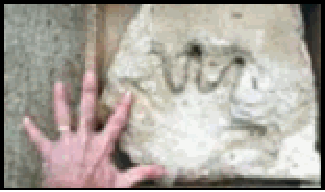
In the recent past, miners in South Africa dug up metal spheres that are approximately an inch in diameter. Two types of spheres have been found; one is solid bluish metal with flecks of white and the other is hollowed out containing white spongy material inside. The photograph above is the metal one that has three parallel grooves running around its equator. The rocks they where found in date back 2.8 billion years. The fossilized human handprint shown below was found in limestone that is estimated to be 110 million years old.


Following are excerpts from Forbidden Archeology: The Hidden History of the Human Race by Michael A. Cremo and Richard L. Thompson.
 
In 1979, researchers at the Laetoli, Tanzania, site in East Africa discovered footprints in volcanic ash deposits over 3.6 million years old. Mary Leakey and others said the prints were indistinguishable from those of modern humans. Knowledgeable persons will warn against positing the existence of anatomically modern humans millions of years ago on the slim basis of the Laetoli footprints. But there is further evidence.
 
In 1965, Bryan Patterson and W. W. Howells found a surprisingly modern humerus (upper arm bone) at Kanapoi, Kenya. Scientists judged the humerus to be over 4 million years old. Henry M. McHenry and Robert S. Corruccini of the University of California said the Kanapoi humerus was "barely distinguishable from modern Homo." Similarly, Richard Leakey said the ER 1481 femur (thighbone) from Lake Turkana, Kenya, found in 1972, was indistinguishable from that of modern humans. Scientists normally assign the ER 1481 femur, which is about 2 million years old, to prehuman Homo habilis. But since the ER 1481 femur was found by itself, one cannot rule out the possibility that the rest of the skeleton was also anatomically modern.
 
In 1913, a German scientist, Hans Reck, found at Olduvai Gorge, Tanzania, a complete anatomically modern human skeleton in strata over 1 million years old, inspiring decades of controversy. More evidence like this has been found throughout the globe, providing scientific proof that man has been on this earth for a very-very long time, further showing that the Darwin Theory of Evolution does not stand up to scientific scrutiny.

 http://www.omsriram.com/index_files/Page351.htm

NASA Images Find 1,750,000 Year Old Man-Made Bridge


The Hindustan Times
10-10-2


WASHINGTON (PTI) -- The NASA Shuttle has imaged a mysterious ancient bridge between India and Sri Lanka, as mentioned in the Ramayana.
 
The evidence, say experts matter-of-factly, is in the Digital Image Collection.
 
The recently discovered bridge, currently named as Adam's Bridge and made of a chain of shoals, 30 km long, in the Palk Straits between India and Sri Lanka, reveals a mystery behind it.
 
The bridge's unique curvature and composition by age reveals that it is man-made. Legend as well as Archeological studies reveal that the first signs of human inhabitants in Sri Lanka date back to the primitive age, about 1,750,000 years ago and the bridge's age is also almost equivalent.


http://www.hindustantimes.com/news/181_81164,0003.htm
Courtesy NASA Digital Image Collection
 
 
Space images taken by NASA reveal a mysterious ancient bridge in the Palk Strait between India and Sri Lanka. The recently discovered bridge currently named as Adam&laqno;s Bridge is made of chain of shoals, c.18 mi (30 km) long.
 
The bridge&laqno;s unique curvature and composition by age reveals that it is man made. The legends as well as Archeological studies reveal that the first signs of human inhabitants in Sri Lanka date back to the a primitive age, about 1,750,000 years ago and the bridge&laqno;s age is also almost equivalent.
 
This information is a crucial aspect for an insight into the mysterious legend called Ramayana, which was supposed to have taken place in tredha yuga (more than 1,700,000 years ago).
 
In this epic, there is a mentioning about a bridge, which was built between Rameshwaram (India) and Srilankan coast under the supervision of a dynamic and invincible figure called Rama who is supposed to be the incarnation of the supreme.
 
This information may not be of much importance to the archeologists who are interested in exploring the origins of man, but it is sure to open the spiritual gates of the people of the world to have come to know an ancient history linked to the Indian mythology.


Comment
From Hugh Joseph
10-12-2
 
Hi Jeff...
 
I read the story headlined above with great interest. This is a story of major significance, as understanding its implications will turn the entire world of Science and History on its head. This bridge, according to accounts in the Ramayana and the Srimad-Bhagavatam, was constructed in the age know as Treta, over 2 million years ago.
 
How did the writers without super space-ranging satellites know about the existence of this bridge? In these ancient accounts, written over 5,000 years ago, we find discussions of, among other things, space travel, inter planetary travel, what we call UFOs and what we mistakenly call ETs. This is not only the History of the planet Earth, but also of this Universe, (a mediocre universe among many millions of universes.)
 
Here one can also learn the real undisguised and uncontaminated truth about God. Our man-made religions are of little or no value when compared to the stunning and breathtaking revelations found in the pages of the Srimad-Bhagavatam, Ramayan, Bhagavad-gita, etc.
 
I hope you will publish this comment for the benefit of your readers.
Thank you for the great work you are doing.
 
Hugh Joseph
 
 
For your readers, here is the way the "Srimad Bhagavatam" describes the event:
 
Text 22
nara-devatvam apannah
sura-karya-cikirsaya
samudra-nigrahadini
cakre viryany atah param
 
Translation:
 
"In the eighteenth incarnation (of Lord Krishna), the Lord appeared as King Rama. In order to perform some pleasing work for the demigods, He exhibited superhuman powers by controlling the Indian Ocean and then killing the atheist King Ravana, who was on the other side of the sea".
 
Purport
(by His Divine Grace A.C. Bhaktivedanta Swami Prabhupada)
 
The Personality of Godhead Sri Rama assumed the form of a human being and appeared on the earth for the purpose of doing some pleasing work for the demigods, or the administrative personalities, to maintain the order of the universe. Sometimes great demons and atheists like Ravana and Hiranyakasipu and many others become very famous due to advancing material civilization by the help of material science and other activities, with a spirit of challenging the established order of the Lord. For example, the attempt to fly to other planets by material means is a challenge to the established order. The conditions of each and every planet are different, and different classes of human beings are accommodated there for particular purposes mentioned in the codes of the Lord. But, puffed up by tiny success in material advancement, sometimes the godless materialists challenge the existence of God. Ravana was one of them, and he wanted to deport ordinary men to the planet of Indra (heaven) by material means without consideration of the necessary qualifications. He wanted a staircase to be built up directly reaching the heavenly planet so that people might not be required to undergo the routine of pious work necessary to enter that planet. He also wanted to perform other acts against the established rule of the Lord. He even challenged the authority of Sri Rama, the Personality of Godhead, and kidnapped His wife, Sita. Of course Lord Rama came to chastise this atheist, answering the prayer and desire of the demigods. He therefore took up the challenge of Ravana, and the complete activity is the subject matter of the "Ramayana". Because Lord Ramachandra was the Personality of Godhead, He exhibited superhuman activities which no human being, including the materially advanced Ravana, could perform. Lord Ramacandra prepared a royal road on the Indian Ocean with stones that floated on the water. The modern scientists have done research in the area of weightlessness, but it is not possible to bring in weightlessness anywhere and everywhere. But because weightlessness is the creation of the Lord by which He can make the gigantic planets fly and float in the air, He made the stones even within this earth to be weightless and prepared a stone bridge on the sea without any supporting pillar. That is the display of the power of God.
 
(Srimad-Bhagavatam First Canto, Chapter 3, text 24, 1972)
 
Here's the account from the "Ramayana" of Sage Valmiki:
 
"At Rama's command, those lions among the monkeys entered the mighty forest with alacrity in hundreds and thousands on every side and those leaders on the simian tribes, tearing up the rocks, which in size they resembled, and the trees also dragged them to the sea and they covered the ocean with Sala, Ashvararna, (list of tree names).Those foremost monkeys transported those trees, with or without roots, bearing them like so many standards of Indra (the king of heaven) and they heaped (list of tree names) here and there. With the aid of mechanical devices, those powerful colossi dug up stones as big as elephants and rocks, and the water suddenly spouted into the air only to fall instantly. Thereafter those monkeys churned up the sea by rushing into it on all sides pulling on the chains.
 
"That immense causeway constructed by Nala in the bosom of the sea was built by the arms of those monkeys of formidable exploits and it extended over a hundred leagues.
 
"Some brought trunks of trees and others set them up; it was by hundreds and thousands that those monkeys, like unto giants, made use of reeds, logs and blossoming trees to construct that bridge, rushing hither and thither with blocks of stone resembling mountains or the peaks of crags, which, flung into the sea, fell with a resounding crash.
 
"The first day those monkeys resembling elephants, or immense energy, full of high spirits and exceedingly merry, erected fourteen leagues of masonry. The second day, those highly active monkeys of formidable stature set up twenty leagues. Bestirring themselves, those giants threw twenty-one leagues of structure over the ocean on the third day and on the fourth, working feverishly, they built up twenty-two leagues in extent. The fifth day, those monkeys, industrious workers, reached to twenty-three leagues distance from the further shore.
 
"That fortunate and valiant son of Vishvakarma (architect of the demigods), leader of the monkeys, constructed a causeway worthy of his sire over the ocean and that bridge erected by Nala over the sea, the haunt of whales, dazzling in its perfection and splendor, was like the constellation of Svati in space.
 
"Then the gods, Gandharvas, Siddhas (living beings superior to humans) and supreme Rishis (great sages) assembled in the sky, eager to see that masterpiece, and the gods and Gandharvas gazed on that causeway, so difficult of construction, that was ten leagues in width and a hundred in length built by Nala.
 
"Those monkeys thereafter dived, swam and shouted at the sight of that unimaginable marvel that was almost inconceivable and caused one to tremble! And all beings beheld that causeway thrown over the ocean and by hundreds and thousands of kotis (millions), those monkeys, full of valor, having built that bridge over the immense repository of waters, reached the opposite shore.
 
"Vast, well-constructed, magnificent with its wonderful paved floor, solidly cemented, that great causeway like unto a line traced on the waves, resembled the parting of a woman's hair.
 
"Meanwhile Bibishana (brother of Ravana who joined Rama), mace (club) in hand, held himself ready at his post with his companions in case of an enemy attack. Thereafter Sugriva addressed Rama, who was valiant by nature, saying "Mount on the shoulders of Hanuman and Laxmana (brother of Rama) on those of Angada. O Hero, vast is this ocean, the abode of whales; those two monkeys who freely range the sky will transport you both."
 
"Then the fortunate Rama and Laxmana advanced thus and that magnanimous archer was accompanied by Surgriva. Some monkeys strode forward in the center, some threw themselves into the waves, some sprang into the sky, others marched on the bridge, some ranged through space like birds, and the terrific tumult of the trampling of that formidable army of monkeys drowned the roar of the ocean.
 
"When those simian troops had passed over the sea by the grace of Nala's causeway, the king ordered them to camp on the shore which abounded in roots, fruits and water.
 
At the sight of that masterpiece that had materialized under the command of Raghava (another name of Lord Rama), despite the difficulties, the gods, who had drawn near with the Siddhas and Charanas as also the great Rishis, anointed Rama in secret there, with water form the sea, and said: "Mayest thou be victorious over thy foes, O Thou, who are a God among men! Do Thou rule over the earth and the sea eternally!"
 
Thus in various auspicious words, did they acclaim Rama in the midst of the homage offered to him by the Brahmins."
 
(The Ramayana of Valmiki, Yuddha Kanda)
 
Note: Lord Krsna's incarnation Rama, appeared as a human being because only a human being could kill Ravana, due to certain benedictions that he had been given.
 
Note: The monkeys mentioned here as comprising Rama's army, were not ordinary monkeys. They were in fact greatly powerful demigods who appeared on this earth to assist the Lord in his pastime of subduing this atheistic demon, Ravana.
 
Note: There are 4 ages, or yugas, rotating through time like the 4 seasons: Satya, 1,800,000 yeas long; Dvarapa, 1,200,000 years long, Treta, 800,000 years long and Kali, 432,000 years long. In this most recent yuga cycle, the Dvarapara and Treta yugas were reversed. This event took place about 2 million years ago.
 
Comments welcome
hughjoseph@aol.com
 
 http://rense.com/general30/nasa.htm

Tuesday, October 9, 2012

The Philosophy of the Upanishads


The Upanishads are the end part of the Vedas which briefly expound the philosophic principles of the Vedas and are considered the essence of the Vedas. The philosophy of the Upanishads is sublime, profound, lofty and soul-stirring. The Upanishads speak of the identity of the individual soul and the Supreme Soul. They reveal the most subtle and deep spiritual truths. There are total 108 Upanishads according to the Muktika Upanishad. Of these, the following 12 are considered the principle Upanishads. They are: 1. Isa, 2. Kena, 3. Katha, 4.Taitiriya, 5. Aitareya, 6. Prashna, 7. Mundaka, 8. Mandukya, 9. Chandogya, 10. Svetasvatara, 11. Brihad-aranyaka, 12. Maha-Narayana. Another 8, called minor Upanishadas, are: 1. Kaivalya, 2. Kaushitaki, 3. Atma, 4. Amritabindu, 5. Brahma, 6. Paramahamsa, 7. Sarva & 8. Aruni (Aruneyi).

The term Upanishad denotes the study and practice of the innate truth. The name is full of significance. ‘Upa’ means the process of studying with ‘Nishta’ or steadfastness; ‘shad’ means the attainment of the Ultimate Reality. The name Upa-ni-shad arose for these reasons. The Upanishads teach not only the principles of Atmavidya; they indicate also the practical means of realisation. They point out not only the duties and obligations one has to bear, but also the actions to be done and those to be avoided.

The Gita is but the essence of the Upanishads. Arjuna acquired through the lessons of the Gita the fruit of listening to the Upanishads. In the Upanishads, the statement, “Thath-thwam-asi”, “That thou art”, is found. In the Gita, Krishna says to Arjuna, “I am Arjuna among the Pandavas”, that is to say, “I and You are the same”. This is the same as saying “Thou art That”, that Jiva and Iswara are the same.

So, whether it is the Gita or the Upanishads, the teaching is Non-duality, not Duality, or qualified Monism. The human eye cannot delve into the minute or the magnitudinous. It cannot read the mystery of the virus or the atom or the stellar universe. Therefore, scientists supplement the eye with the telescope and the microscope. Similarly, sages are able to experience Divinity through the eye of knowledge, gained by following the Dharma of moral conduct and spiritual discipline. When the human eye stands in need of an extraneous instrument to observe even the insignificant worm and virus, how can one refuse to go through the process of manthra if he desires to see the omnipresent transcendent Principle? It is very hard to acquire the eye of wisdom. Concentration is essential for this. And, for concentration to develop and stabilise itself, three things are very important: purity of consciousness, moral awareness and spiritual discrimination. These qualifications are difficult of attainment by ordinary folk.

Man is endowed with the special instrument of discrimination, of judgement, of analysis and synthesis, which among all animals, he alone possesses. He has to develop this and utilise it to the best purpose. Through this instrument, he can realise the Immanent Divinity.

Instead, man pesters himself and others with the question: Where does God reside? If He is real, why is He not seen? Hearing such queries, one feels like pitying the poor questioners. For, they are announcing their own foolishness. They are like the dullards who aspire for university degrees without taking pains even to learn the alphabet. They aspire to realise God without putting themselves to the trouble of practising the Sadhana required. People who have no moral strength and purity talk of God and His existence and decry efforts to see Him. Such people have no right to be heard.

Spiritual Sadhana is based on the holy Sastras. They cannot be mastered in a trice. They cannot be followed through talk. Their message is summed up in the Upanishads; hence, they are revered as authoritative. They are not the products of human intelligence; they are the whisperings of God to man. They are parts of the eternal Vedas. The Vedas shine gloriously through all their parts.

The Upanishads are authentic and authoritative, as they share the glory of the Vedas. They are 1180 in number, but, through the centuries, many of them disappeared from human memory and only 108 have now survived. Of these, 13 have attained great popularity, as a result of the depth and value of their contents.

The sage Vyasa classified the Upanishads and allotted them among the four Vedas; The Rigveda has 21 branches and each branch has one Upanishad allotted to it. The Yajurveda has 109 branches and 109 Upanishads. The Atharvanaveda has 50 branches and 50 Upanishads were its share. The Samaveda has a thousand branches and the balance, namely, 1000 Upanishads were its share. Thus, the 1180 Upanishads were assigned by Vyasa to the Four Vedas.

Sankaracharya raised the status of ten among the Upanishads by selecting them for writing his commentaries and so they became especially important. Humanity stands to gain or fall by these ten. Pundits and those with faith should resolve to present before humanity these ten Upanishads at least. They are Isa, Kena, Katha, Prasna, Mundaka, Mandukya, Thaithiriya, Aithareya, Chandogya and Brihadaranyaka.

The Upanishads have also inspired other works on Geography, Astronomy, Astrology, Economics and Political Theory, as well as the 18 Puranas comprising Skanda, Siva, Garuda and others. The Vedas and the Upanishads are the very foundation for Sanathana Dharma.

There is one interesting feature to be noted. This religion has no one Founder as the others have. That invisible unknown founder is God, the source of all wisdom. He is the Prophet of this Sanathana Dharma. He is the Founder; His Grace and His Inspiration manifested through the pure Sages and they became the spokesmen of this Dharma. When the moral purity of men degenerates, God takes form as grace and inspiration in sages and teachers. He has also given through the Upanishads the Sathya-Jnana, the Wisdom concerning the Reality.

The Lord, intent on the regeneration of the world, communicated Vedas through Hiranyagarbha and Hiranyagarbha, in turn, passed Them on to his ten Manasa-puthras, including Athri and Marichi. From them, the Vedas spread among humanity, handed down from one generation to another. As time passed, ages accumulated and continents moved, some Vedas got lost, or were neglected as too difficult for comprehension, and only Four have survived into modern times. These Four were taught by Vedavyasa, the greatest among the exponents of the Vedas, to his disciples, in the Dwaparayuga.

When Vyasa was thus expounding the Vedas, engaged in spreading the sacred scripture, one disciple of his, Yajnavalkya by name, incurred his wrath and as a punishment, he had to regurgitate the Yajurveda that he had already learned, into the custody of his guru and leave the place, to take refuge in Suryadeva, the treasure-house of the Vedas. Just then, the Rishis who revere the Vedas, flew into the place in the shape of Thiththiri birds and ate up the regurgitated Yajurveda. That particular section of the Veda is called “Thaithiriyam”.

Meanwhile Suryadeva was pleased with the devotion and steadfastness of the unfortunate Yajnavalkya. He assumed the form of a Vaji or Horse and blessed the sage with renewed knowledge of the Yajurveda. The sections thus taught by the Vaji came to be called ‘Vajasaneyi’. The Yajurveda as promoted by Vedavyasa is called Krishna paksha Yajurveda and that handed down by Yajnavalkya as the Sukla paksha Yajurveda. In these, the first few chapters are Manthras connected with the Karmakanda and the last few sections deal with Jnanakanda.

While these are the most important Upanishads, the others also have a lot to teach us about the various aspects of Divinity and life.

 http://www.astrojyoti.com/aboutupanishads.htm

Upanishads

Upanishad means the inner or mystic teaching. The term Upanishad is derived from upa (near), ni (down) and s(h)ad (to sit), i.e., sitting down near. Groups of pupils sit near the teacher to learn from him the secret doctrine. In the quietude of the forest hermitages the Upanishad thinkers pondered on the problems of deepest concerns and communicated their knowledge to fit pupils near them. Samkara derives the word Upanishad as a substitute from the root sad, 'to loosen.,' 'to reach' or 'to destroy' with Upa and ni as prefixes and kvip as termination. If this determination is accepted, upanishad means brahma-knowledge by which ignorance is loosened or destroyed. The treatises that deal with brahma-knowledge are called the Upanishads and so pass for the Vedanta. The different derivations together make out that the Upanishads give us both spiritual vision and philosophical argument. There is a core of certainty which is essentially incommunicable except by a way of life. It is by a strictly personal effort that one can reach the truth.

The Upanishads more clearly set forth the prime Vedic doctrines like Self-realization, yoga and meditation, karma and reincarnation, which were hidden or kept veiled under the symbols of the older mystery religion. The older Upanishads are usually affixed to a particularly Veda, through a Brahmana or Aranyaka. The more recent ones are not. The Upanishads became prevalent some centuries before the time of Krishna and Buddha. 

The main figure in the Upanishads, though not present in many of them, is the sage Yajnavalkya. Most of the great teachings of later Hindu and Buddhist philosophy derive from him. He taught the great doctrine of "neti-neti", the view that truth can be found only through the negation of all thoughts about it. Other important Upanishadic sages are Uddalaka Aruni, Shwetaketu, Shandilya, Aitareya, Pippalada, Sanat Kumara. Many earlier Vedic teachers like Manu, Brihaspati, Ayasya and Narada are also found in the Upanishads. 

In the Upanishads the spiritual meanings of the Vedic texts are brought out and emphasized in their own right. 

 http://www.hindunet.org/upanishads/

The Upanishads - Supreme Work of the Hindu Mind

The Upanishads form the core of Indian philosophy. They are an amazing collection of writings from original oral transmissions, which have been aptly described by Shri Aurobindo as "the supreme work of the Indian mind". It is here that we find all the fundamental teachings that are central to Hinduism — the concepts of 'karma' (action), 'samsara' (reincarnation), 'moksha' (nirvana), the 'atman' (soul), and the 'Brahman' (Absolute Almighty). They also set forth the prime Vedic doctrines of self-realization, yoga and meditation. The Upanishads are summits of thought on mankind and the universe, designed to push human ideas to their very limit and beyond. They give us both spiritual vision and philosophical argument, and it is by a strictly personal effort that one can reach the truth. 

Meaning of 'Upanishad'


The term 'Upanishad' literally means, "sitting down near" or "sitting close to", and implies listening closely to the mystic doctrines of a guru or a spiritual teacher, who has cognized the fundamental truths of the universe. It points to a period in time when groups of pupils sat near the teacher and learnt from him the secret teachings in the quietude of forest 'ashrams' or hermitages. In another sense of the term, 'Upanishad' means 'brahma-knowledge' by which ignorance is annihilated. Some other possible meanings of the compound word 'Upanishad' are "placing side by side" (equivalence or correlation), a "near approach" (to the Absolute Being), "secret wisdom" or even "sitting near the enlightened".


Time of Composition


Historians and Indologists have put the date of composition of the Upanishads from around 800 - 400 B.C., though many of the verse versions may have been written much later. In fact, they were written over a very long period of time and do not represent a coherent body of information or one particular system of belief. However, there is a commonality of thought and approach.


The Main Books


Although there are more than 200 Upanishads, only thirteen have been identified out as presenting the core teachings. They are the Chandogya, Kena, Aitareya, Kaushitaki, Katha, Mundaka, Taittriyaka, Brihadaranyaka, Svetasvatara, Isa, Prasna, Mandukya and the Maitri Upanishads. One of the oldest and longest of the Upanishads, the Brihadaranyaka says:

"From the unreal lead me to the real!
From darkness lead me to light!
From death lead me to immortality!"

The crux of the Upanishads is that this can be achieved by meditating with the awareness that one's soul ('atman') is one with all things, and that 'one' is 'Brahman', which becomes the 'all'.


Who wrote the Upanishads?


The authors of the Upanishads were many, but they were not solely from the priestly caste. They were poets prone to flashes of spiritual wisdom, and their aim was to guide a few chosen pupils to the point of liberation, which they themselves had attained. According to some scholars, the main figure in the Upanishads is Yajnavalkya, the great sage who propounded the doctrine of 'neti-neti', the view that "truth can be found only through the negation of all thoughts about it". Other important Upanishadic sages are Uddalaka Aruni, Shwetaketu, Shandilya, Aitareya, Pippalada, Sanat Kumara. Many earlier Vedic teachers like Manu, Brihaspati, Ayasya and Narada are also found in the Upanishads. 

 http://hinduism.about.com/od/scripturesepics/a/upanishads.htm